Part II
We stayed in Hunza for the next five days, mainly at Apple Garden based in Aliabad. Due to this, we became quite familiar with the friendly staff, and they also treated us very well. Sometimes we wandered around the village on our own. Other times, we went out for day trips. Only once, to see the Passu Glacier, did we stay at a hotel right on the banks of alpine Borith Lake. The hotel was situated at a beautiful location, extremely tranquile and peaceful, with lovely facilities.
I became interested in Hunza because I came to know by chance that the famous Japanese animated movie “Nausicaä of the Valley of the Wind,” directed by Hayao Miyazaki, was inspired by this place. I thus persuaded my friends to join me on this tour. Before setting out, I did some homework and learnt that Hunza is located in the Gilgit-Baltistan special administrative region, in the far north of Pakistan.
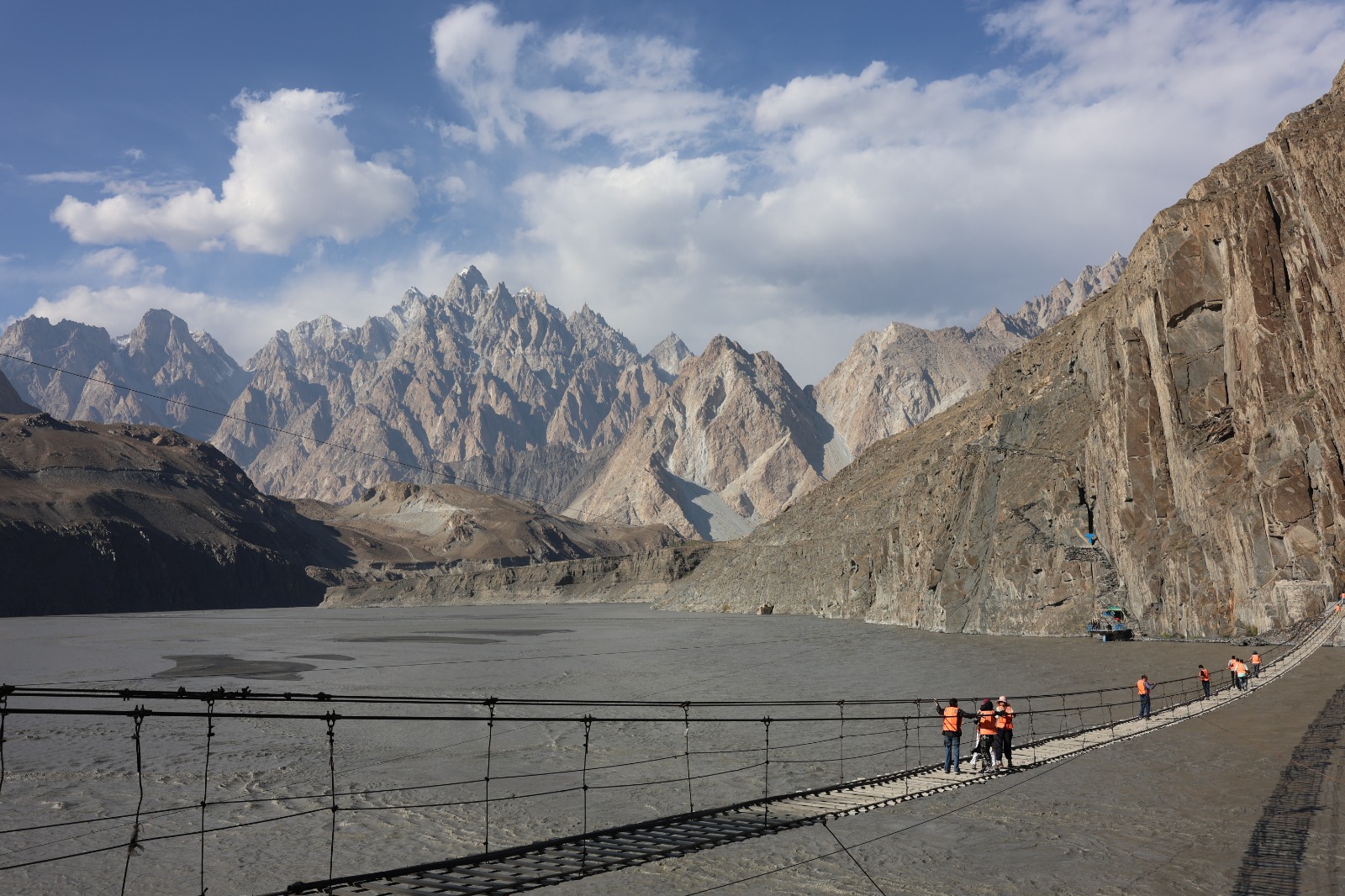
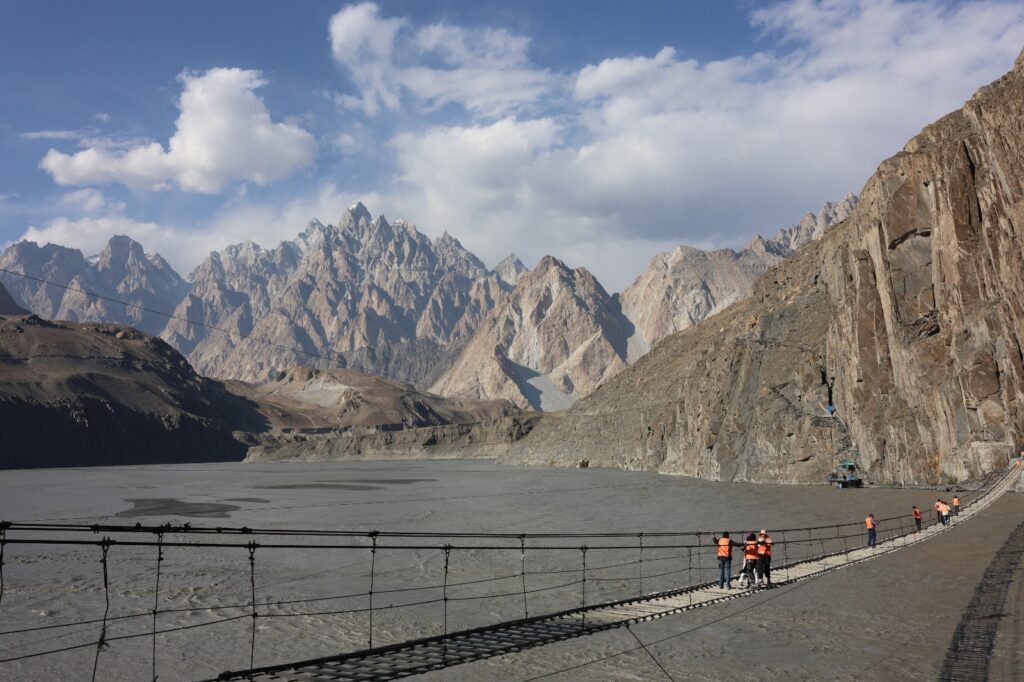
It sits at the crossroads between Pakistan, China, and Afghanistan, and is surrounded by some of the highest mounatain ranges of the world: the Himalayas, Hindu Kush, and Karakorams. Hunza River cuts right through the Karakoram mountain ranges, forming a breathtaking canyon landscape.
Historically, Hunza was ruled by the Ayasho Dynasty, a small independent kingdom. At the end of the nineteenth century, it became the “playground” for the “Great Game” between the political powers of Great Britain and Russia, due to its strategic geopolitical location. In 1891, British forces invaded and incorporated Hunza into its “Gilgit Agency,” subjecting it under indirect rule.
After the independence and partition of India and Pakistan, Hunza announced that it would join Pakistan but remain semi-autonomous. In 1974, Pakistan formally abolished the hereditary rule of the Ayasho kings, and incorporated Hunza into its administrative system, as a district within the northern regions.
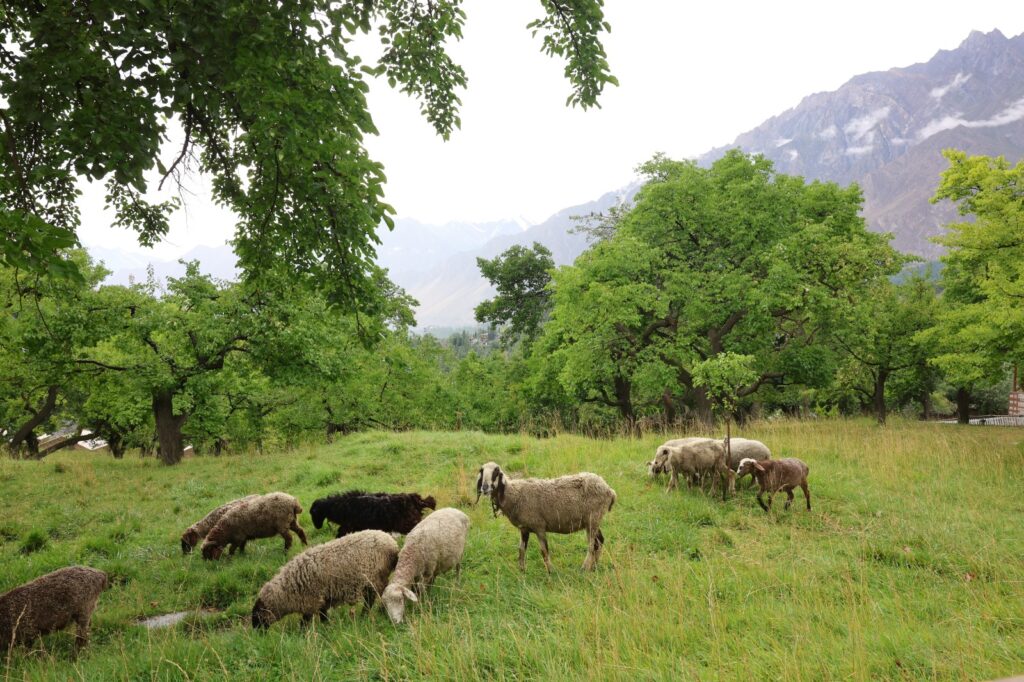
In the early days, the inhabitants of Hunza Valley relied entirely on intricte irrigation systems, carved and built from the steep rock valley-sides. Through these complex irrigation channels, the melting glacier waters from the mountain peaks would flow down into the villages to nourish the wheat, barley, and famed apricot trees grown on terraced fields. Villagers also interspersed their labor between alpine agriculture and pastoralism, seasonally herding yaks, goats and sheep in higher and lower pastures.
The Karakoram Highway, inaugurated in 1978, ended Hunza’s longterm geographical isolation. The highway not only served as an economic artery between Pakistan and China, but also created an opening for modern developments, education propagation, and a flourishing tourism industry, which in turn gave us a chance to visit this mysterious valley.
I also read that Hunza is often described by outsiders as an “utopia,” where people enjoyed longevity and health due to their simple diets and livestyles. Although research has shown that this is a “myth” born from romanticized mis-understanding of Hunza people’s hard lives in these mountainous regions, yet this image of a “pure mountain community” does indeed attract many visitors, artists and creators.
According to documented interviews with Hayao Miyazaki, the director said that he was inspired by the majestic valley terrain and the local community’s resilience when creating “Nausicaä of the Valley of the Wind.” In particular, the ways that the local community co-exist with nature through their ingenious irrigation system, to not only survive in this originally harsh, steep and fallow valley, but re-make it into lush green stepped orchards…this became the prototype of the village depicted in Miyazaki’s movie.
Harboring our anticipation of exploring the inspiration behind “Valley of the Wind,” we embarked on the first daytrip of our cultural tour in Hunza Valley. It was a visual feast of ancient villages and castles. In the morning, we stepped into the thousand-year-old village of Ganish, an ancient caravan stop on the Silk Road.
We marveled at the heritage sites crafted from wood, clay and stones. The village is protected by thick high walls, flanked with a water pool also designed for defense. Inside the walls, several ancient wooden mosques co-exist, decorated with eclectic religious carvings, a testament to the cultural exchanges happening on this ancient trade route. I could imagine the different clans living here together for mutual defense on this important crossroad of civilizations.
After Ganish village, we enjoyed lunch inside royal grounds nearby: the Serena Hotel’s restaurant within the Altit Fort gardens served us an exquisite and incredibly satisfying meal of meat stews, rice, and flatbreads. We visited the Altit Fort in light rain, surrounded by giant mountain peaks that towered above us at 7000 meters.
The fort has a history of 1100 years and is strikingly perched on the top of a crag, with just a thin line of Hunza River far below. We met a passionate guide who was equally skilled at telling stories of past royal life inside the fort and making impressive one-cut videos of our entourage. He helped us make many precious documentations of our visit.
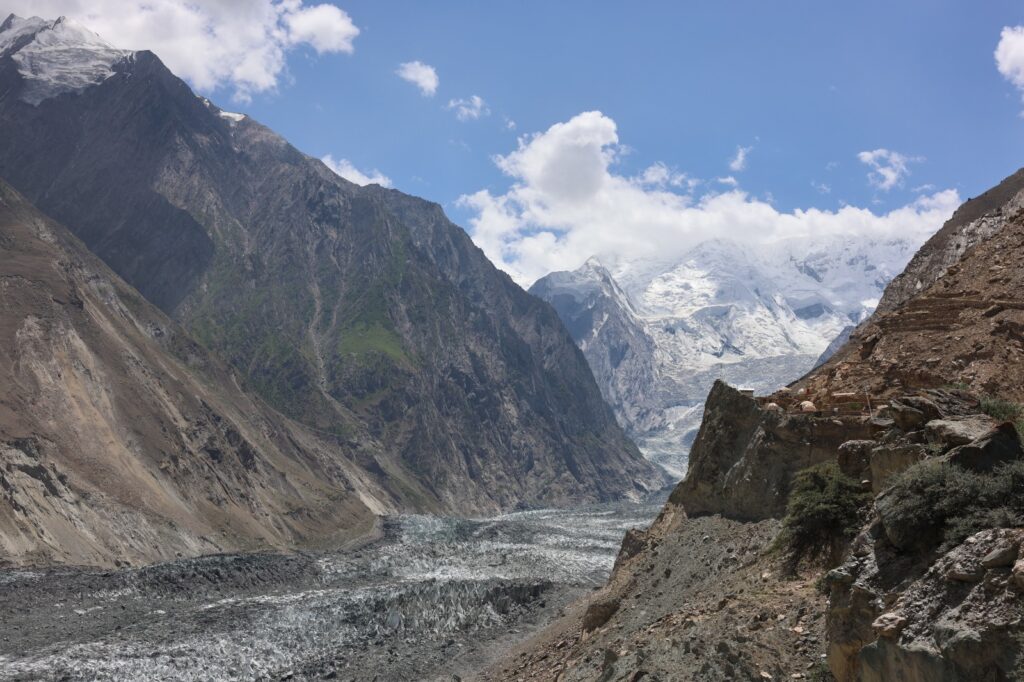
The next day, we went to see a “black glacier.” It was quite a mental shock, as I had always imagined glaciers to be white. Our group members also started to feel some challenging effects of long-distance travel. In the morning, we spent a long time bumping in the van on the small winding road to visit the Hopper Glacier, located “just around” the other side of the mountain.
When we finally reached, I was surprised to see that the lower portion of the glacier, due to many sediments of mud and sand, looked quite dirty. We had to trek higher to see the un-muddy-iced part of the glacier. This day was also a turning point for our physical conditions, as many of us in the group started to feel gastrointestinal discomfort due to the long travels and difference in climate and diets.
Our tour guide quickly adjusted our dinner back at Apple Garden, to simple stir-fried beans and a wild vegetable soup, which our stomachs happily welcomed. He even brought us a magical herbal stew for stomach aliments, which had an interesting flavor and was quickly finished off by us all.
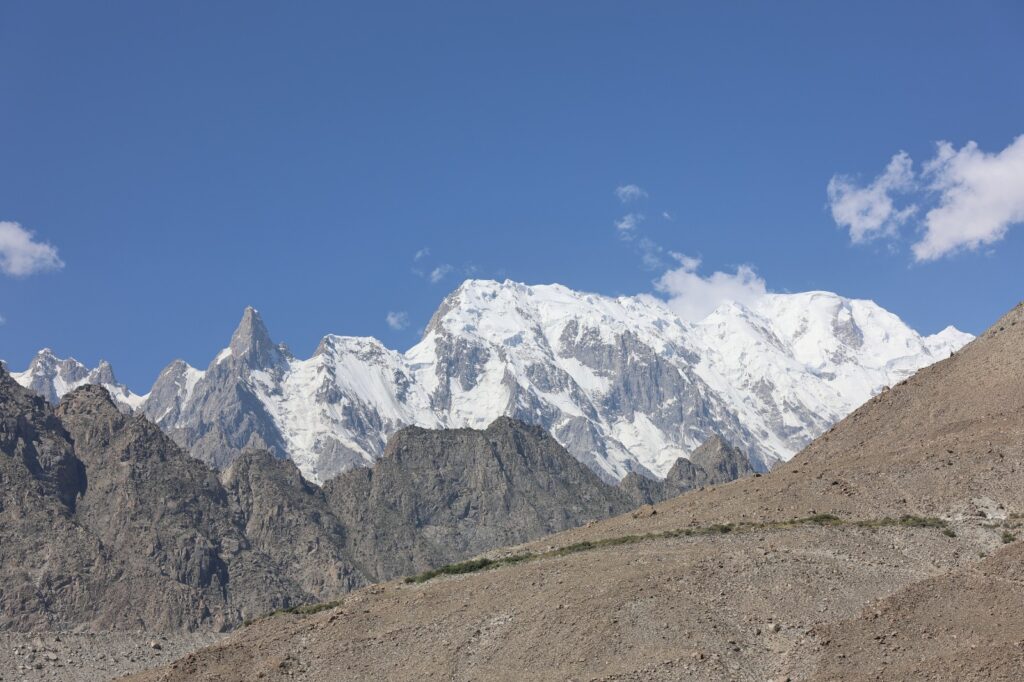
The next day, we decided to take things slower and relax in Aliabad village. At 5am in the morning, I challanged myself to climb to the highest point of the natural road outside our lodging. It was a thrilling and memorable experience. Apple Garden is located on the outskirts of the main settled area, with paths to the high mountains just on its backdoor. These are peaks that embrace layers of snow in winters; even in summer, the snow line remained visible.
On my way back from my individual adventure, I bumped into one of our tour fellows, my friend who is a retired biology teacher. She was happily identifying the plants along the path, and told me that they are desert-type vegetation, remanants of the Ice Age. What an interesting and educational morning walk!
Later that day, we took a short car ride to Murtazabad, another village on the other side of the valley. From there, the view of Aliabad was spectacular. In our walk around the village of Murtazabad, I was able to observe close-up the irrigation channels, the various crops planted in the gardens, the animals being raised. We also saw many black flags, raised for mourning Hussain, the Prophet Muhammad’s grandson, at the Shia mosque in this village. I’m so glad that the good people at Magpie Tours custom-tailored this part of our cultural tour. It was truly an unique and insightful immersion into Hunza local life.