
In July 2025, our group of six family and friend members departed from Taipei. We took a Thai Air flight which transited through Bangkok. Not too bad, around 4-5 hours per leg. That evening, we successfully arrived in Islamabad, the capital of Pakistan.
We set out the very next morning aboard our very own tour minibus. This blog documents our 10-day tour and travel experiences on the road, in our journeys through the Hunza and Skardu valleys of northern Pakistan. We chose this custom group tour package arranged by Magpie Tours Pakistan, a travel agency based locally in Hunza, recommended by my daughter’s friends. Given the difficult logistics of mountain transportation, it was great to relax and “enjoy” the ardours of journeying itself, without the many additional hassles of bookings, tickets, dealing with checkpoints…
Northern Pakistan is a region that spans some of the highest mountain ranges in the world. The whole area was ruled by seven independent small kingdoms, with their unique cultures and languages. Gradually, due to historical processes too complex to share here, these kingdoms joined the Islamic Republic of Pakistan soon after the country’s independence from British rule in 1947.
From the moment we departed Islamabad, I was mentally prepared that this would not just be a journey through space, but a test of my physical and sensory endurance. At 70 years old, I’ve been to many places around the world. Yet the high mountains in this part of the world was a first for me. We headed northwards and upwards along the Karakoram Highway (often called KKH for short). It’s a highway connecting Pakistan and China, but not just any highway. Hailed as the “Eighth Wonder of the World,” you can only experience it to see why. This is a road that hangs daringly along cliff edges like a lifeline.
On the first official day of our journey, we departed at a leisurly time of 11 a.m. Soon, we enjoyed a delicious lunch at a rest area consisting of chicken, lentils, and flatbreads (rotis). The most interesting sights along the way were the elaborately decorated, vibrantly colored painted trucks, as well as roadside vendors selling tomatoes and peaches, and even cages of chickens being transported on cargo trucks.
We sat snugly in our private minibus. Locally, this is called a “wagon,” and indeed it did feel quite “wagon-like” to jolt on it along the narrowly winding, sometimes uneven mountainous highway. For hours and hours, our bodies rose and fell with the rising terrain. It was truly humbling to experience the hardships of transport in such mountain areas.
That evening we stayed at Besham Inn. Dinner included chicken and vegetable fried noodles, roast chicken, and a warming chicken soup. Now we understood the high volumn of truck-tranported chichens along the way! Our hotel room was right on the Indus River’s edge, and we fell asleep to the thunderous echoes of rushing water.
The second day brought an early-morning challenge. To catch the checkpoint opening time, we had to rise and shine at 3 a.m. We found armed guards on strict watch in both the hotel lobby and entrance. Mixed feelings of securitization!
Breakfast was simple but flavorful. We were alloted one egg and half a flatbread per person. Charmingly, our guide also brought us banana and peach, perhaps understanding our need for fiberous fruits. Later, at a rest stop with abundant water sources, we sat among locals to drink a warming green tea, different from the green teas of Taiwan. Although the KKH started off beautifully paved, road conditions became particularly poor in the dam construction zone, but we also observed planned greening projects along the Indus River.
We had set out from warm ochre plains the day before. The scenery changed turn by turn, often with the Indus River roaring far below. As we rose in height, we watched the scenery transform from lush green into towering, desolate mountains.
I had always heard the term “roof of the world” but not really comprehended what it truly meant. Entering the Gilgit-Baltistan region, the embodied experience of “being” on the roof of the world finally hit me. Before reaching Gilgit, the administrative center of the Gilgit-Baltistan region, we made a brief stop at a magnificent site: the confluence point of three great mountain ranges, namely, the Himalayas, Karakoram, and Hindu Kush. It felt like we were standing under the central dome of a grand cathedral, supported by these three massive stone pillars. It’s not hard to imagine, that before the highway was created, this had been a secret and isolated realm, entirely cut off from the world.

After arriving in Gilgit at noon, we enjoyed an upscale lunch at a five-star hotel with gorgeous food and views. Before entering Aliabad, we made a special trip to the mountainside to view the spectacular glacier-carved Hunza Valley and taste local wild-thyme tea, called tumuro, which our guide said was good for the respiratory system.
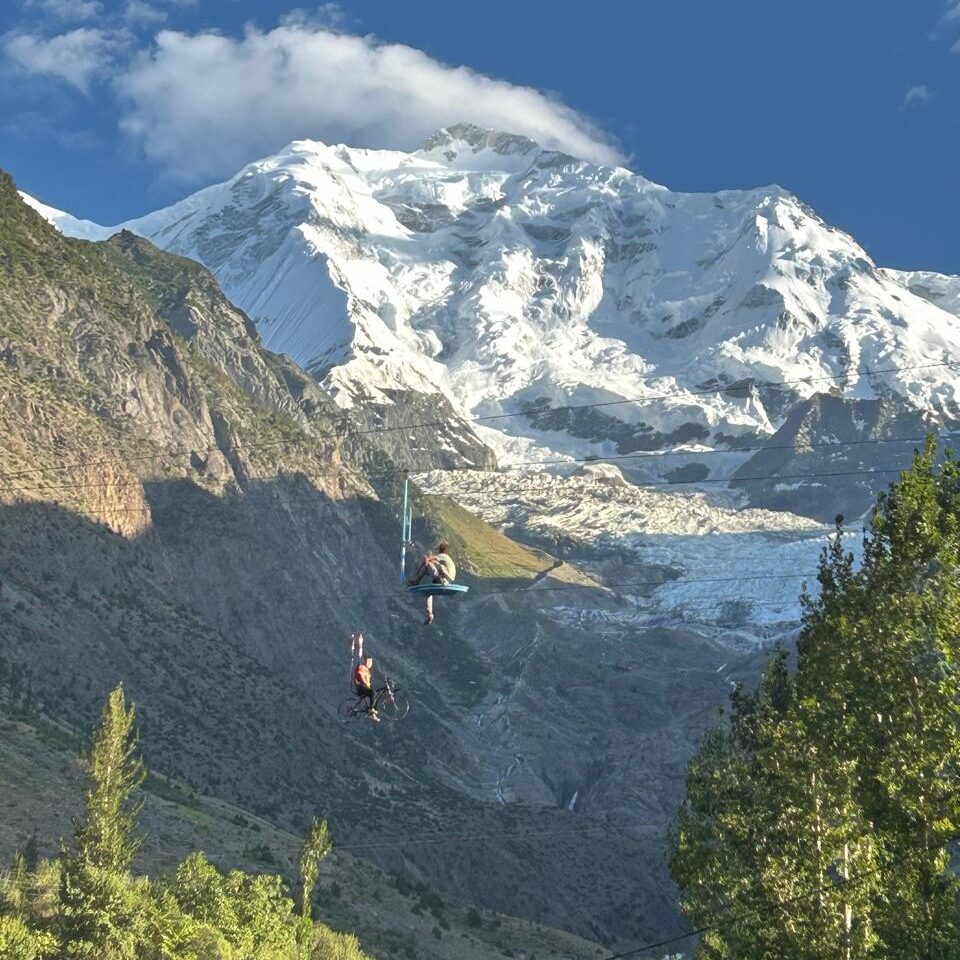
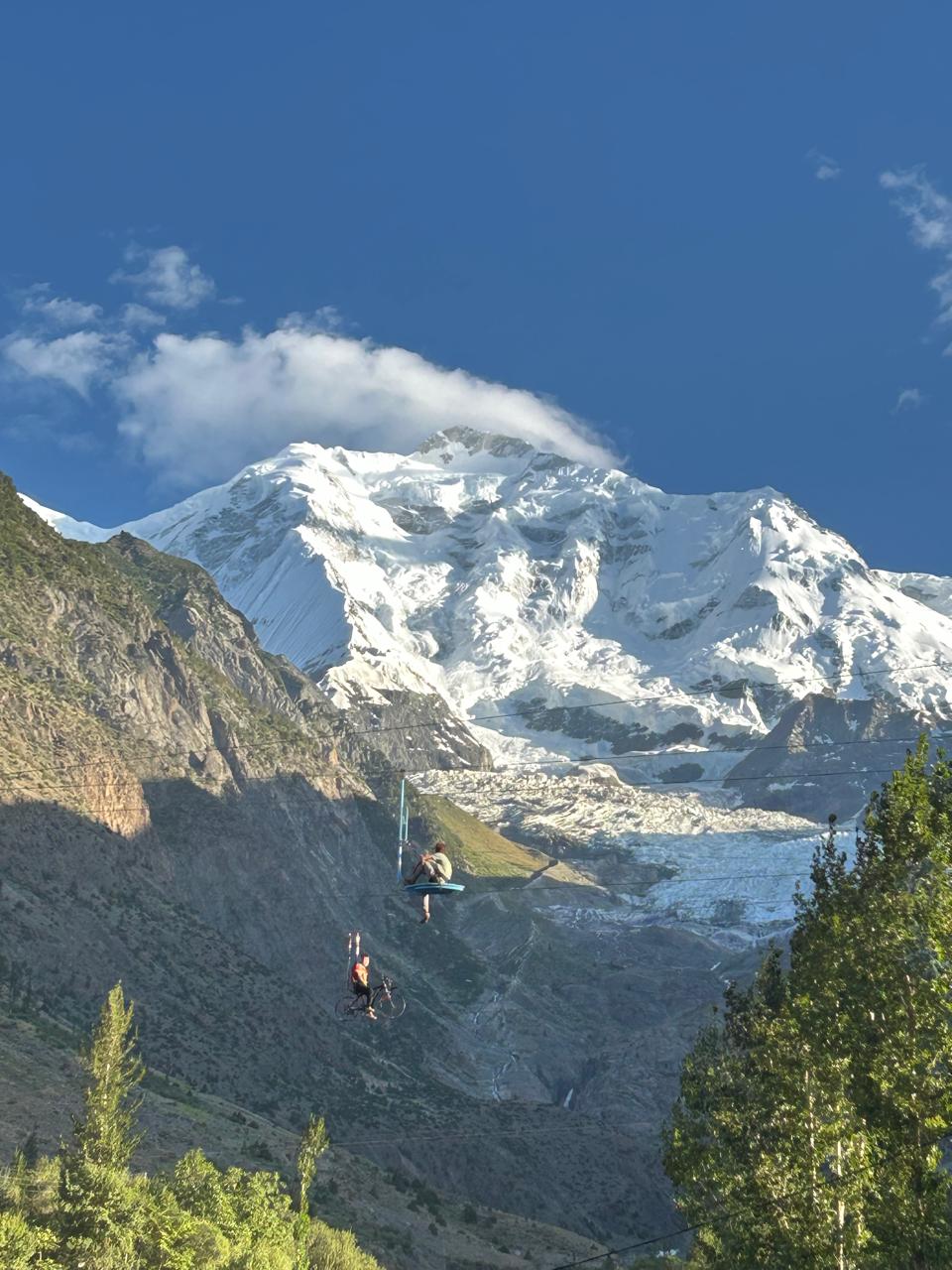
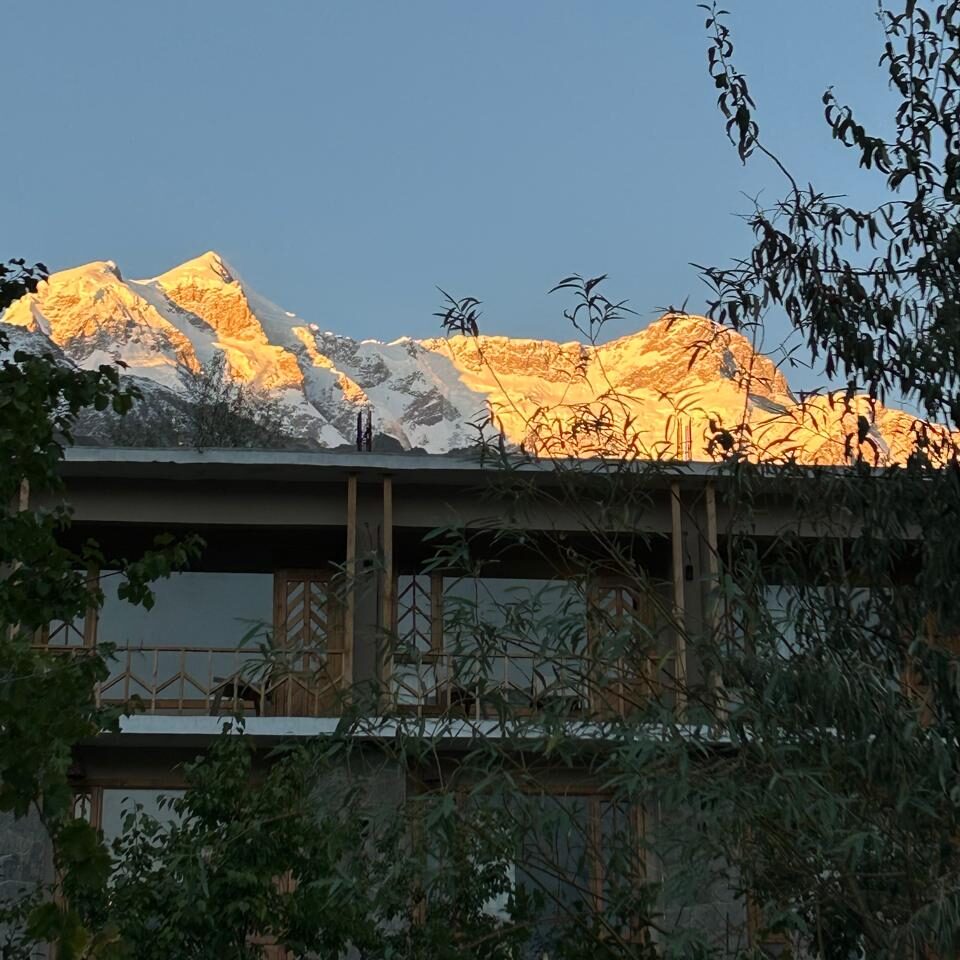
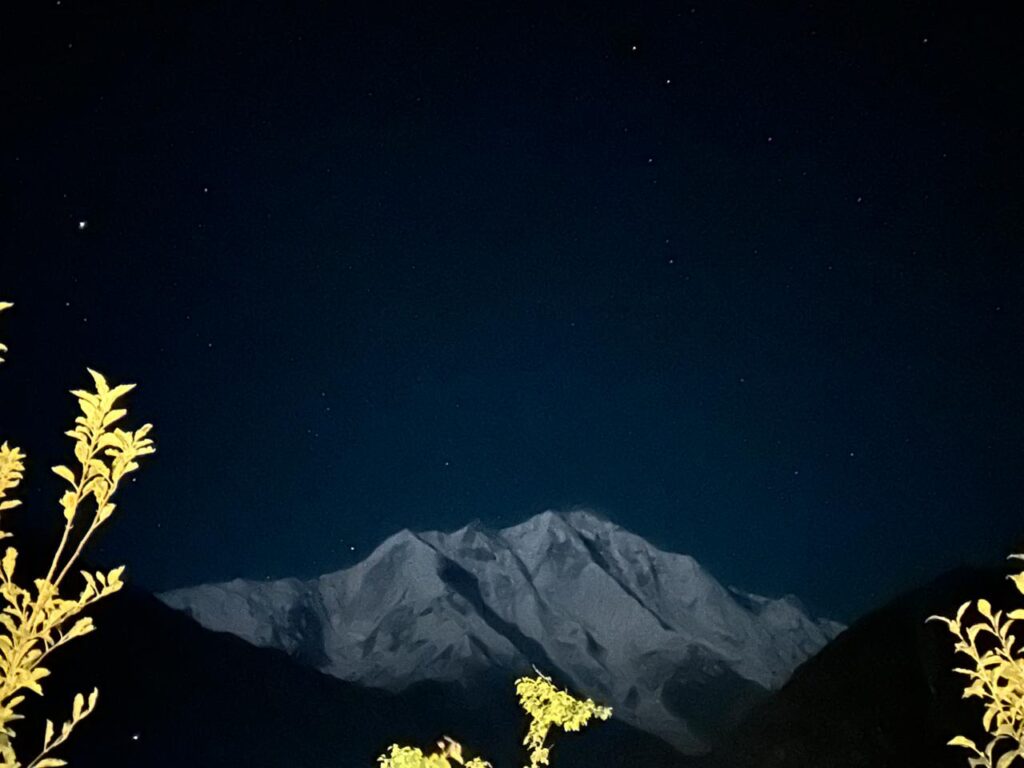
When we finally arrived at our lodging, the Apple Garden Guesthouse in Aliabad, Hunza, the high-altitude thin air was causing me a slight dull headache. My breathing also became more and more labored as we reached around 2400 meters in elevation. But all of this dissolved the moment I opened our bedroom door. From the room, I could simply lie on the bed and gaze in tranquile silence upon the breathtaking Rakaposhi Peak through the full-length balcony window. At 7788 meters elevation, its snow-covered peak stood serenely before me, radient in the sunlight.
The next morning, I strolled through the guesthouse’s gardens. Was it my imagination, or could I wiff a sense of glaciors in the coolness of the air? Underfoot, I picked my way through an abundance of fallen ripe apricots. Some had just dropped from the branches above, and I took advantage of their freshness to taste their pure sweetness, melting on the tongue.
After the desolate mountains flanking our KKH road trip, this apricot tree-filled garden felt like an oasis. Perching in the middle of the verdant Hunza valley, the sweet fragrance of ripe apricots in the crisp cool air, I sensed something awaken inside. A tranquile prelude, a page opens, to our travels among the snow-capped mountains to come.
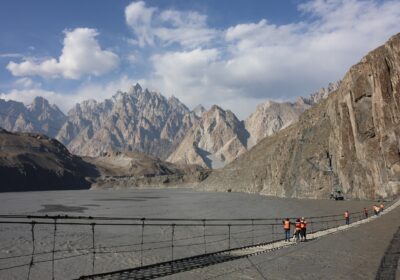
We stayed in Hunza for the next five days, mainly at Apple Garden based in Aliabad. Due to this, we became quite familiar with the friendly staff, and they also treated us very well. Sometimes we wandered around the village on our own. Other times, we went out for day trips. Only once, to see the Passu Glacier, did we stay at a hotel right on the banks of alpine Borith Lake. The hotel was situated at a beautiful location, extremely tranquile and peaceful, with lovely facilities.
I became interested in Hunza because I came to know by chance that the famous Japanese animated movie “Nausicaä of the Valley of the Wind,” directed by Hayao Miyazaki, was inspired by this place. I thus persuaded my friends to join me on this tour. Before setting out, I did some homework and learnt that Hunza is located in the Gilgit-Baltistan special administrative region, in the far north of Pakistan. It sits at the crossroads between Pakistan, China, and Afghanistan, and is surrounded by some of the highest mounatain ranges of the world: the Himalayas, Hindu Kush, and Karakorams. Hunza River cuts right through the Karakoram mountain ranges, forming a breathtaking canyon landscape.

Historically, Hunza was ruled by the Ayasho Dynasty, a small independent kingdom. At the end of the nineteenth century, it became the “playground” for the “Great Game” between the political powers of Great Britain and Russia, due to its strategic geopolitical location. In 1891, British forces invaded and incorporated Hunza into its “Gilgit Agency,” subjecting it under indirect rule. After the independence and partition of India and Pakistan, Hunza announced that it would join Pakistan but remain semi-autonomous. In 1974, Pakistan formally abolished the hereditary rule of the Ayasho kings, and incorporated Hunza into its administrative system, as a district within the northern regions.
In the early days, the inhabitants of Hunza Valley relied entirely on intricte irrigation systems, carved and built from the steep rock valley-sides. Through these complex irrigation channels, the melting glacier waters from the mountain peaks would flow down into the villages to nourish the wheat, barley, and famed apricot trees grown on terraced fields. Villagers also interspersed their labor between alpine agriculture and pastoralism, seasonally herding yaks, goats and sheep in higher and lower pastures.
The Karakoram Highway, inaugurated in 1978, ended Hunza’s longterm geographical isolation. The highway not only served as an economic artery between Pakistan and China, but also created an opening for modern developments, education propagation, and a flourishing tourism industry, which in turn gave us a chance to visit this mysterious valley.
I also read that Hunza is often described by outsiders as an “utopia,” where people enjoyed longevity and health due to their simple diets and livestyles. Although research has shown that this is a “myth” born from romanticized mis-understanding of Hunza people’s hard lives in these mountainous regions, yet this image of a “pure mountain community” does indeed attract many visitors, artists and creators. According to documented interviews with Hayao Miyazaki, the director said that he was inspired by the majestic valley terrain and the local community’s resilience when creating “Nausicaä of the Valley of the Wind.” In particular, the ways that the local community co-exist with nature through their ingenious irrigation system, to not only survive in this originally harsh, steep and fallow valley, but re-make it into lush green stepped orchards…this became the prototype of the village depicted in Miyazaki’s movie

Harboring our anticipation of exploring the inspiration behind “Valley of the Wind,” we embarked on the first daytrip of our cultural tour in Hunza Valley. It was a visual feast of ancient villages and castles. In the morning, we stepped into the thousand-year-old village of Ganish, an ancient caravan stop on the Silk Road. We marveled at the heritage sites crafted from wood, clay and stones. The village is protected by thick high walls, flanked with a water pool also designed for defense. Inside the walls, several ancient wooden mosques co-exist, decorated with eclectic religious carvings, a testament to the cultural exchanges happening on this ancient trade route.
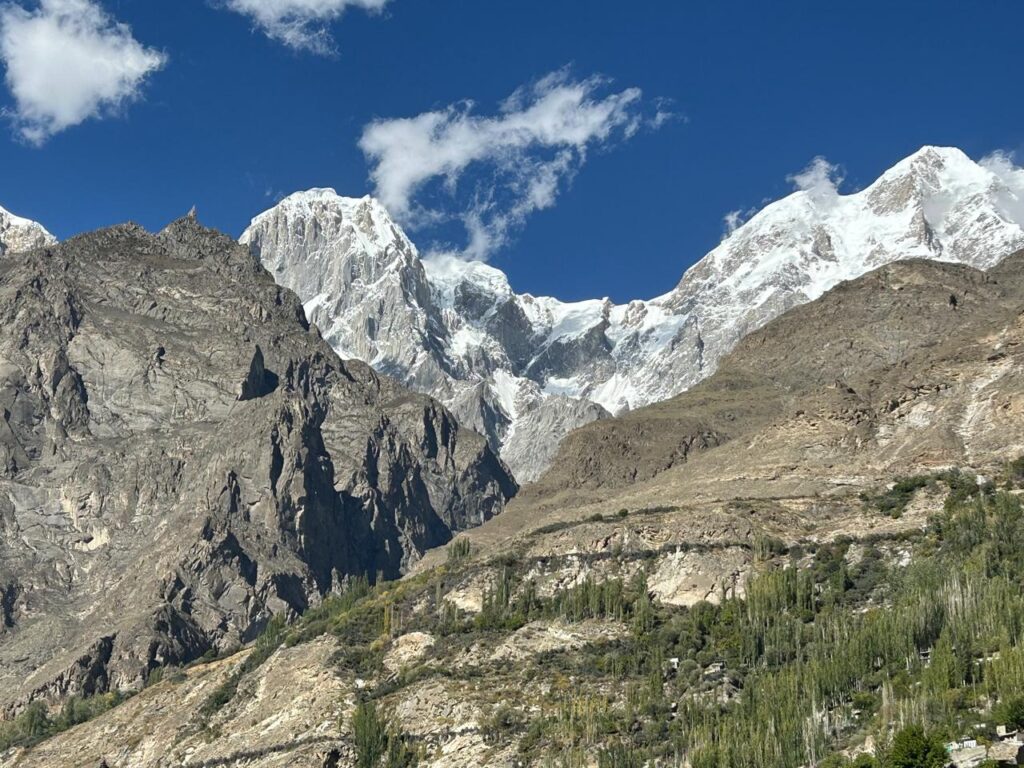
I could imagine the different clans living here together for mutual defense on this important crossroad of civilizations. After Ganish village, we enjoyed lunch inside royal grounds nearby: the Serena Hotel’s restaurant within the Altit Fort gardens served us an exquisite and incredibly satisfying meal of meat stews, rice, and flatbreads. We visited the Altit Fort in light rain, surrounded by giant mountain peaks that towered above us at 7000 meters. The fort has a history of 1100 years and is strikingly perched on the top of a crag, with just a thin line of Hunza River far below. We met a passionate guide who was equally skilled at telling stories of past royal life inside the fort and making impressive one-cut videos of our entourage. He helped us make many precious documentations of our visit.
The next day, we went to see a “black glacier.” It was quite a mental shock, as I had always imagined glaciers to be white. Our group members also started to feel some challenging effects of long-distance travel. In the morning, we spent a long time bumping in the van on the small winding road to visit the Hopper Glacier, located “just around” the other side of the mountain. When we finally reached, I was surprised to see that the lower portion of the glacier, due to many sediments of mud and sand, looked quite dirty. We had to trek higher to see the un-muddy-iced part of the glacier.
This day was also a turning point for our physical conditions, as many of us in the group started to feel gastrointestinal discomfort due to the long travels and difference in climate and diets. Our tour guide quickly adjusted our dinner back at Apple Garden, to simple stir-fried beans and a wild vegetable soup, which our stomachs happily welcomed. He even brought us a magical herbal stew for stomach aliments, which had an interesting flavor and was quickly finished off by us all.
The next day, we decided to take things slower and relax in Aliabad village. At 5am in the morning, I challanged myself to climb to the highest point of the natural road outside our lodging. It was a thrilling and memorable experience. Apple Garden is located on the outskirts of the main settled area, with paths to the high mountains just on its backdoor. These are peaks that embrace layers of snow in winters; even in summer, the snow line remained visible. On my way back from my individual adventure, I bumped into one of our tour fellows, my friend who is a retired biology teacher. She was happily identifying the plants along the path, and told me that they are desert-type vegetation, remanants of the Ice Age. What an interesting and educational morning walk!
Later that day, we took a short car ride to Murtazabad, another village on the other side of the valley. From there, the view of Aliabad was spectacular. In our walk around the village of Murtazabad, I was able to observe close-up the irrigation channels, the various crops planted in the gardens, the animals being raised. We also saw many black flags, raised for mourning Hussain, the Prophet Muhammad’s grandson, at the Shia mosque in this village. I’m so glad that the good people at Magpie Tours custom-tailored this part of our cultural tour. It was truly an unique and insightful immersion into Hunza local life.